


IT IS NOT YOUR BACK. IT IS YOUR CHAIR.
VESU Orthopedic Seat + Lumbar Cushion Set
VESU Orthopedic Seat + Lumbar Cushion Set
🦴 Cut away under the tailbone, so nothing presses where it hurts
🪑 Turns the chair you already own into one that stops fighting you
🚗 Office, ute, dining chair, flights. It moves with you
Couldn't load pickup availability

VESU Orthopedic Seat + Lumbar Cushion Set

Get it between - and -.
Specifications
Specifications
- Foam: high-density memory foam, both pieces
- Seat: cut-out coccyx relief channel, weight carried on the sit bones
- Lumbar: contoured support with adjustable chair strap
- Bases: non-slip, so neither piece travels while you move
- Covers: removable, machine washable cold
What's in the box
What's in the box
1 x VESU Orthopedic Seat Cushion
1 x VESU Orthopedic Lumbar Cushion
1 x adjustable chair strap
2 x removable washable covers
Shipping Details
Shipping Details
All orders are processed between 1-3 days.
Delivery Times:
Australia
- Standard (Free Tracked Shipping): 6 to 10 business days
- Priority (Paid): 5 to 8 business days
New Zealand
- Standard (Free Tracked Shipping): 6 to 10 business days
The delivery estimates above are total times from order placement to delivery and already include our standard processing window. Delivery times are estimates only and may vary due to carrier delays, public holidays, weather events, peak periods, or other circumstances outside our control.
Returns & Refunds
Returns & Refunds
Changed your mind? Contact us within 30 days of delivery and we'll arrange a return. To be accepted it needs to come back complete — both cushions, both covers, the strap and original packaging — in resaleable condition. Return postage is at your cost unless it arrived faulty, damaged or not what you ordered. Refund goes back to the original payment method within 5 business days of us receiving and checking it.
This is our own change-of-mind policy and it sits in addition to your rights under the Australian Consumer Law. Nothing here limits or replaces those rights.


Thirty days
Thirty Days On Your Own Chair
Sit on it for a month — long enough to feel a Thursday afternoon, not just the novelty of day one. If it is not for you, contact us within 30 days of delivery and we will arrange a return. Complete, in its packaging, in resaleable condition.

The 5pm Problem
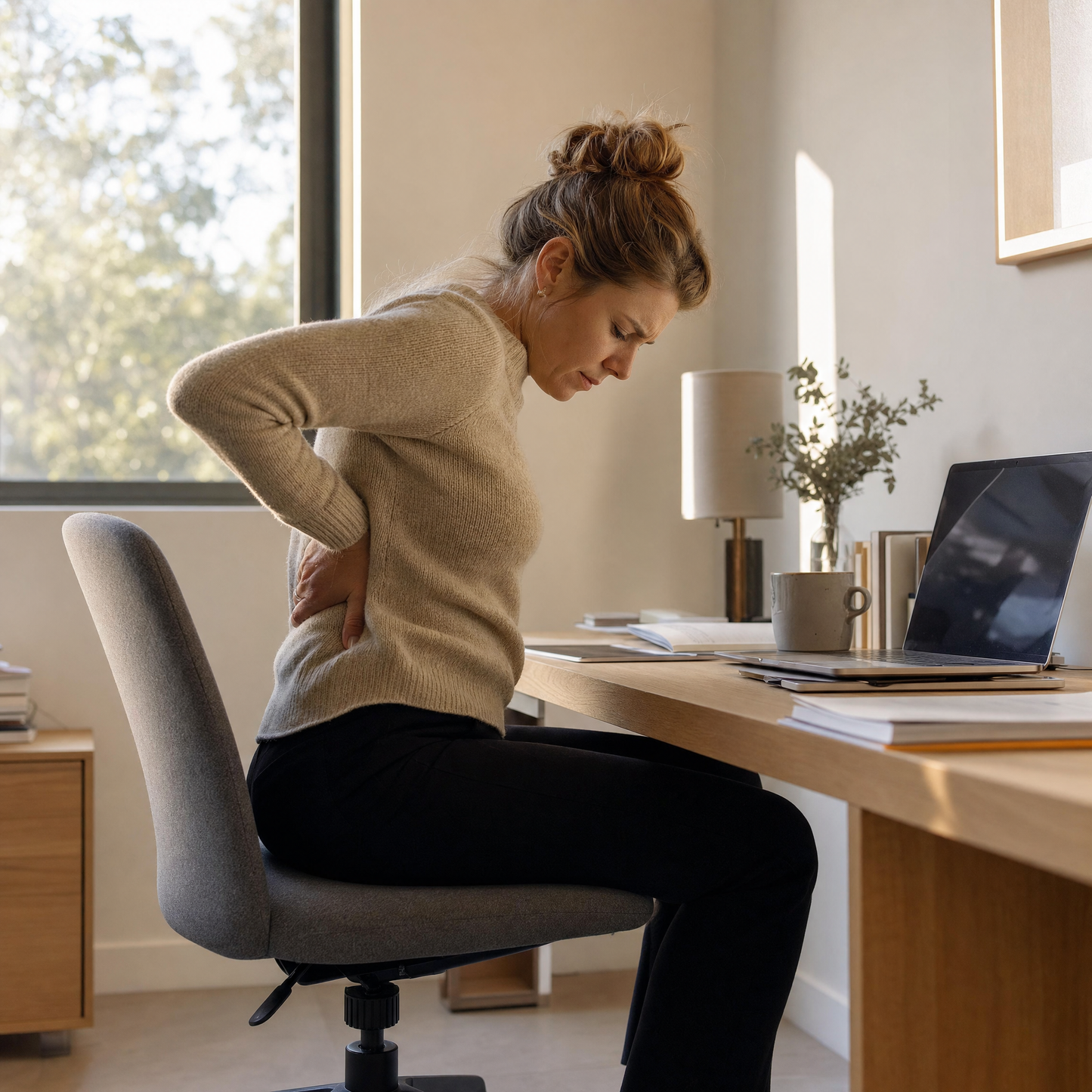
At nine you're sitting up straight. By eleven you've slid forward. By three you're folded over the desk with your feet hooked around the chair legs, and when you finally stand up at five, something in your lower back has to click before it'll let you walk properly.
You've quietly decided this is age. You're thirty-four.
It isn't age. Sitting is a load-bearing activity and almost nobody treats it as one. Your tailbone takes pressure it was never built to take, your pelvis rolls backward to escape it, and your lower spine gives up its curve to follow. Eight hours a day, five days a week. The ache at five o'clock isn't a mystery, it's the bill.
So we fixed both halves. Nothing presses on the tailbone, and the lower back keeps the curve the chair flattens.
What the research actually found
Develop real pain from sitting
In a controlled sitting study, 39% of healthy adults became “pain developers” inside a single prolonged session. It is not in your head and it is not weakness.
Less lower-back pain
When the trunk and pelvis were given extra contact support instead of being left unsupported, pain developers reported 47% less low back pain.
Australians
Live with a back problem — roughly one in six of us. If it feels like everyone at your office has a bad back, they do.
Cause of disability
Low back pain is the single leading cause of disability worldwide. Not a niche complaint, and not something that resolves on its own.
Sources: De Carvalho & Callaghan, Ergonomics 2022, on office chair design and sitting-induced pain (doi 10.1080/00140139.2022.2152113). Choi, Kang & Jin, Ergonomics 2025, on additional trunk and pelvis contact support (doi 10.1080/00140139.2025.2582581). Australian Bureau of Statistics, National Health Survey 2021–22, reported by the Australian Institute of Health and Welfare. World Health Organization, Low Back Pain fact sheet 2023. Retrieved via PubMed. These are findings about sitting and about back problems in the population — they are not claims about this product, and this is not a medical device.
Five signs this is your problem
How it works
Cushion on the seat
Cut-out to the rear, over your tailbone. Weight lands on the sit bones instead.
Lumbar at belt height
Strap around the backrest. Small of the back, not between the shoulders — too high and it shoves you forward.
Sit back, not forward
With the gap filled there is finally something to sit back into. That is the whole change.
Fix both halves at once
The cushion takes the pressure off. The lumbar stops it happening in the first place.
Choose your bundleOne set, four problems
Why The Cheap Ones Fail
We bought them first. The inflatable ones lose pressure inside a fortnight. The thin foam ones pancake by month two and then you're sitting on an extra layer of nothing.
| VESU | Inflatable cushions | Thin foam cushions | |
|---|---|---|---|
Still supportive after twelve months |
|||
Lumbar support included, not sold separately |
|||
Nothing pressing on the tailbone |
|||
Holds pressure without deflating |
|||
Non-slip, stays put when you move |
|||
30-day change-of-mind returns |
What to expect, honestly
What people say after a month
Not day one. Month one, because that is when you can tell a novelty from a change.
Long enough to feel a Thursday afternoon
Not a novelty on day one. If standing up at five is still an event, send it back.
Choose your bundleCollapsible content
Will it fit my chair?
Will it fit my chair?
The seat cushion sits on any flat seat, so office chairs, dining chairs, car seats and lounges are all fine. The lumbar support has an adjustable strap that goes around the backrest. The only chairs it struggles with are deep bucket seats where there's nothing to strap to.
How long before I notice anything?
How long before I notice anything?
The first ten minutes feel strange, because you're used to pressure that's suddenly not there. Most people stop noticing the cushion by day two and notice the difference at five o'clock instead. If your pain is long-standing, give it a few weeks rather than a few days.
Will it flatten out like the last one?
Will it flatten out like the last one?
That's down to foam density, which is the boring specification that decides everything. Cheap cushions use low-density foam that compresses permanently within weeks. This uses high-density foam that returns to shape.
Do I need both pieces?
Do I need both pieces?
They solve different halves of the same problem. The seat cushion takes pressure off the tailbone. The lumbar support stops your pelvis rolling backward in the first place. Using one without the other works, but you're fixing the symptom and leaving the cause, which is why we put them together.
Where exactly should the lumbar sit?
Where exactly should the lumbar sit?
At the small of your back, roughly level with your belt line. Too high and it pushes your shoulders forward, which is the mistake almost everyone makes on day one. If it feels like it is shoving you, slide it down.
Can I wash the covers?
Can I wash the covers?
Both covers unzip and go in the machine on cold. Air dry them. The foam itself is spot-clean only.
Is this a medical device?
Is this a medical device?
No. It is a support cushion for comfort while sitting. It does not treat, diagnose or cure any condition, and results vary from person to person. If your pain is severe, radiating down a leg, or new and unexplained, see a physio or your GP rather than buying a cushion.
Who this isn't for
If your pain is severe, radiating down a leg, or new and unexplained, see a physio or your GP first. A cushion is not a diagnosis.
If your chair is a deep bucket seat with nothing to strap around, the lumbar support has nowhere to anchor.
If you are not sitting for long stretches, you probably do not need this. We would rather say so than take the order.
-

Australian Owned
Local support, AUD pricing
-

Customer Care
Real humans, same-day replies
-
Free Shipping
Free tracked shipping AU & NZ
